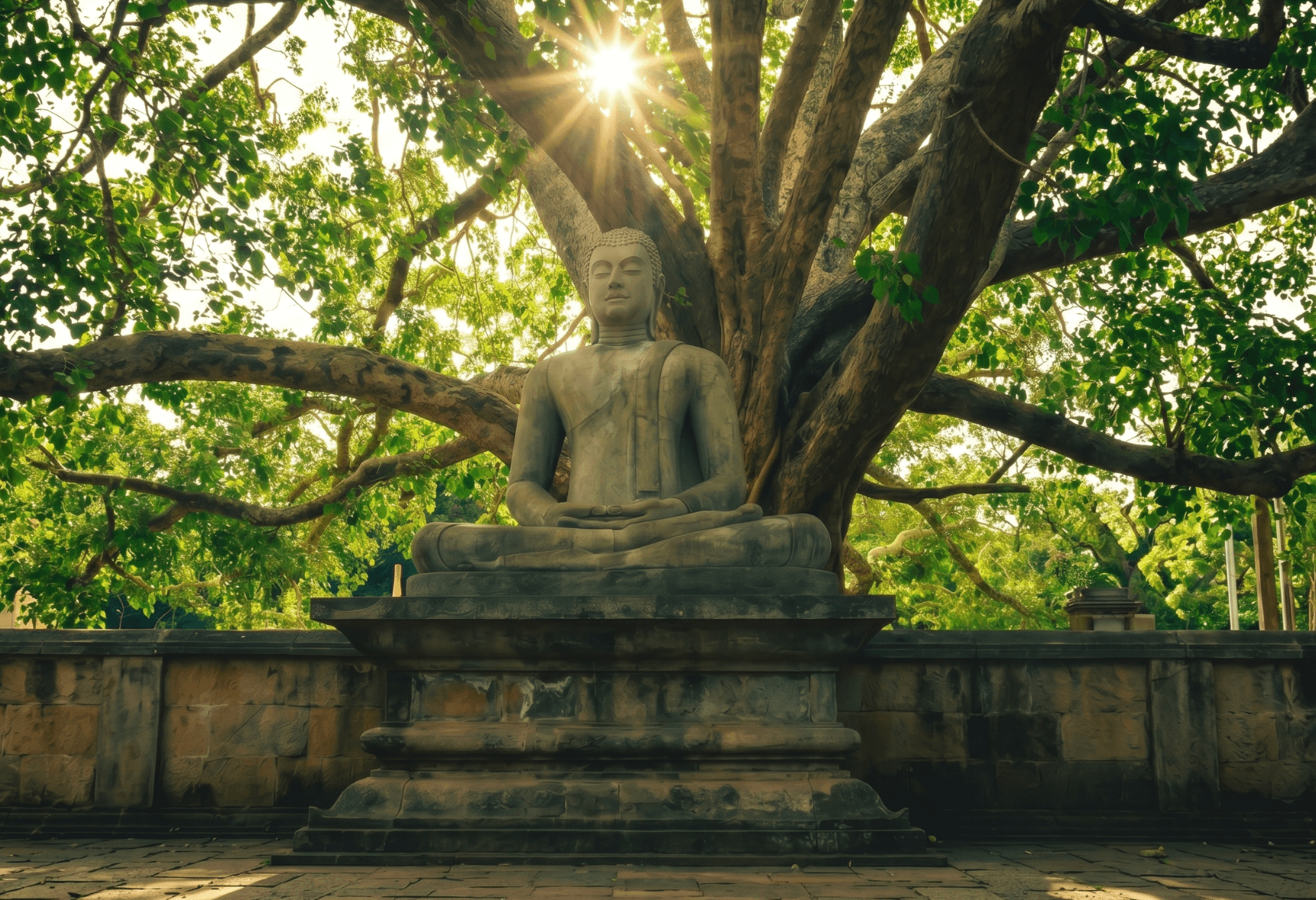
Journey through the sacred Buddha Trail
The Sacred Legacy of Gautama Buddha in Lanka · 5 Nights · 6 Days
The Buddha Trail unfolds across Sri Lanka as one continuous spiritual arc where awakening, teaching, and preservation form a living tradition carried through time.
In Sri Lanka, the sacred journey becomes living continuity. At Aluvihara Rock Temple, the Tripiṭaka was written in the 1st century BCE, preserving the teachings for future generations. In Anuradhapura, one of the world's oldest continuously inhabited sacred cities, devotion continues through stupas, rituals, and pilgrimage. At Jaya Sri Maha Bodhi, the sacred Bodhi sapling brought from Bodh Gaya in the 3rd century BCE remains a living presence of enlightenment.
According to tradition recorded in the Mahavamsa, the Buddha is believed to have visited Sri Lanka, with Kelaniya among the sacred sites associated with these visits. This continuity deepens in the 3rd century BCE with the arrival of Mahinda Thera during the reign of King Devanampiya Tissa. Their meeting at Mihintale marks a defining transformation — where understanding becomes acceptance, establishing Buddhism as a living tradition in Sri Lanka.
Over centuries, Sri Lanka has become a guardian of the Dhamma. The teachings are preserved at Aluvihara Rock Temple on palm leaves to safeguard them for generations, while sacred cities such as Anuradhapura, Polonnaruwa, and Kelaniya continue as living centres of devotion where practice remains uninterrupted.
If Nepal represents origin and India represents enlightenment and teaching — Sri Lanka represents preservation and continuity. Together, they form a complete arc of awakening carried forward through time.
Within the Buddha Trail, Sri Lanka is not a concluding chapter but a living presence where teaching becomes lived reality — still unfolding in devotion and daily life.
*Excluding Flight Price


 Call us